

Take from the orginal text written by the late Leslie Cram in 2012
and published by the Harby History Group
2026 additions to the text by Matt Smith are highlighted in Black
Pre-Christianity
I’ve often wondered what determined the position and placement of our parish church. The land surrounding it lies on the north-east peak of the old parish. The area that falls away from the graveyard is known as the Wong, and it boasts outstanding panoramic views from the north-west hills into Nottinghamshire, then around to the north-east towards Belvoir Castle. One advantage of this outlook is its almost unbroken east-west sunrise and sunset — something quite unique in this area, especially within the Vale parishes.
This has, for a long time, led me to believe that the land may have been used for pre-Christian druid worship before Christianity arrived in Harby. There is no physical evidence to support this — no stones or post-holes to suggest a dwelling. But we do know that the earliest built church here was a barn structure. Whether it was built by the monks who came in the thirteenth century or already existed beforehand, we may never know.
When we look back to a time before Christianity arrived — to a people who had to understand the land, the change from light to dark, the rhythm for survival — the land around our parish church almost lends itself to being the perfect astronomical clock. I do not refer to a stone circle such as a henge, but perhaps something far more simplistic: a meeting place where early settlers discussed the land and the needs to survive the harsh Vale weather.
Those villagers would have understood, long before the Gregorian calendar brought structure, that the position of the sun in relation to the land told them what and where to grow, when to slaughter, and how to store food for the darker months before the lighter days returned.
I suspect that, having written those thoughts, some might recoil at the idea that our parish could have known any worship other than Christian. Some past historians have painted pre-Christian times with fear and disbelief in order to create one narrative. Some even find it inconceivable to understand that this church would have been Catholic before Henry VIII's reformation of 1539. But we must show respect to the past as we must to the future. After all, are we not moving towards a more earthly respectful way of thinking — one where we care for our spiritual lives along with the planet we live on?
Whether it is coincidence or legacy, it is, in my opinion, a special place — one where I truly believe the past meets the future. I have visited many churches, but, hand on heart, I can say that Harby Church has an atmosphere that is unique to me. Some people refer to this as the “thin space” — the space where we are closest to those who have gone before. A place that is not only a physical building but holds a deeply spiritual connection. Perhaps linked to ancient ley lines driven by the very earth it stands upon.
Like all parishes, Harby Church is where the forebears who once worshipped within its walls now lie at rest surrounding it. They contributed to the life of the church and the village in their own way. They were, the butcher, the baker and certainly the candlestick maker.
H-H-H©MAS
Origins of the Settlement
The name Harby (originally recorded as Hardebi) indicates that the village originated as a Scandinavian settlement, probably established around AD 850. In Old Norse, harb refers to herds of cattle, while by denotes a settlement. The linguistic evidence therefore supports a foundation by people migrating from northern Europe.
The Domesday book of 1086 gives a detailed incription of Harby Click Here to read
Conversion to Christianity
These early inhabitants were not Christian on arrival. However, limited historical records from the period — including the Anglo-Saxon Chronicle — describe the progressive Christianisation of Scandinavian settlers throughout England.
1200 – The Earliest Church
Early Church Structure
The first church erected on the present site was almost certainly a wooden structure. It would have consisted of a simple, elongated rectangular form resembling a barn, divided into two distinct areas:
-
The Nave (western section): used by the local community for assembly and worship.
-
The Chancel (eastern section): used by the clergy, containing an altar positioned against the east wall.
The assumption of an early wooden building is based on widespread construction practices of the time; many churches began in timber, leaving only post-hole traces once the structure had decayed. In Harby’s case, physical evidence of this earliest church survives in the west wall of the nave.
Winterbourne Medieval Barn
Earliest Documentary Reference
The first known written reference to the church at Harby occurs in the records of the Bishop of Lincoln. These note that a rector, Robert, was serving the parish in 1220.
Moving forward from 1220 you can study the priests of Harby if you Click Here


1275 – The Stone Tower and Steeple
Sometime in the 13th century, the stone tower that we see today was added to the west end of the church. It has strong corner buttresses to keep it stable. If you look inside the church, you can actually see these buttresses from the east side of the tower, which is also the west wall of the original nave.
Halfway up the tower there’s a row of stones that stick out slightly — this goes around the north, south, and west sides outside. On the inside, you’ll only see this feature near the buttresses, leaving a flat area in the middle where the old wooden nave used to attach. Since the nave was once made of wood, there isn’t any clear line showing where it joined on; if it had been stone, we’d expect to see some trace of that connection today.

Above the west window on the outside of the tower, there’s a small niche where a statue once stood — most likely of St Mary the Virgin, the church’s patron saint.
Just below it there’s a shield-shaped stone, and you can find matching shields on the north and south walls too.
These would probably have been painted with the coats of arms of important local families connected to Harby.
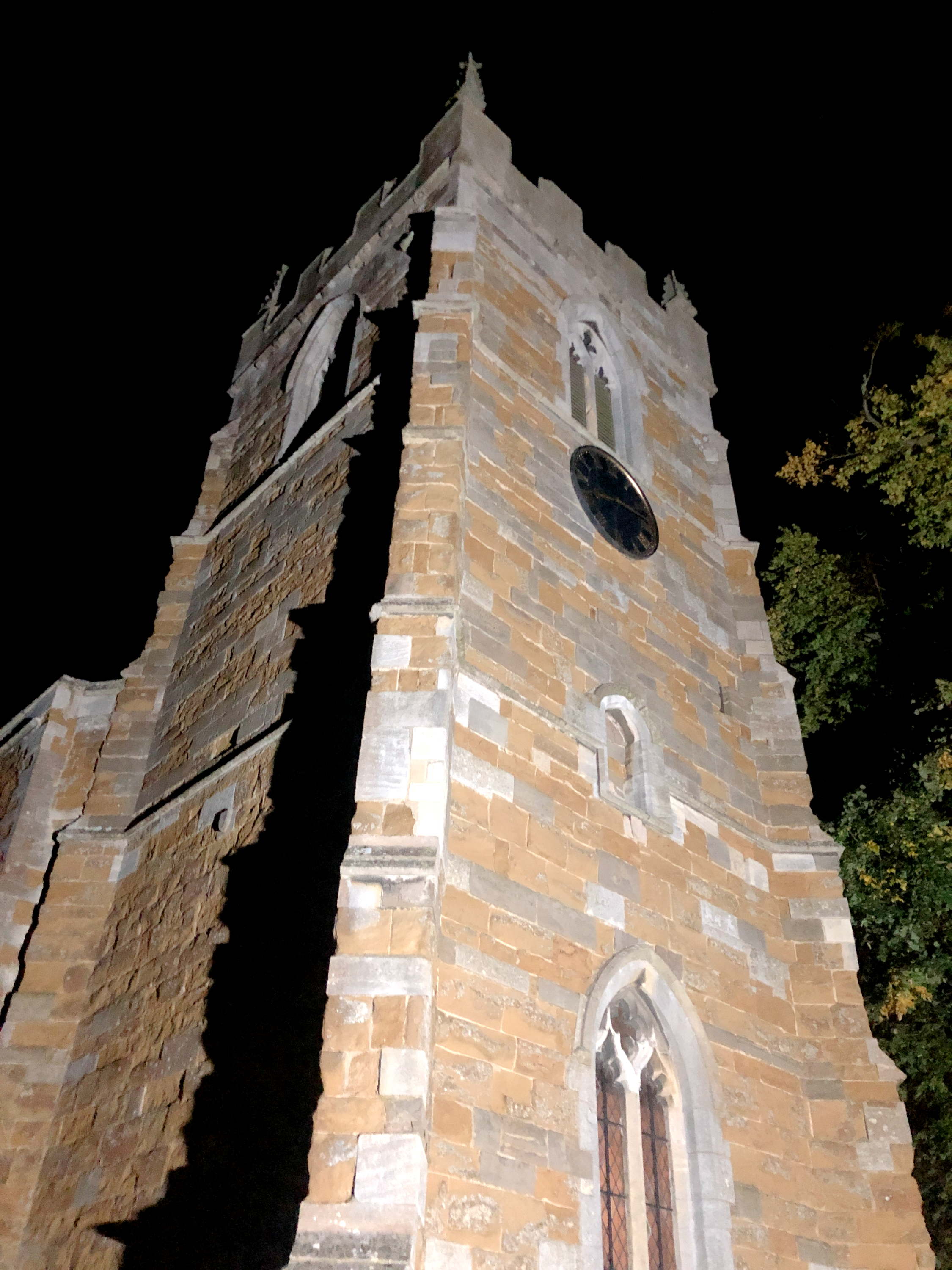
The Tower floodlit at Christmas 2024
This page is working progress and will be contually worked on over the winter of 2025/26

St Mary's in the 1800

Floor plan of Church
This drawing depicts the church as it would have been sometime after the restoration of 1874
